

Van Holland Group INC

New York vs. Miami: what “wealth migration” really measures, and why Florida remains so strong

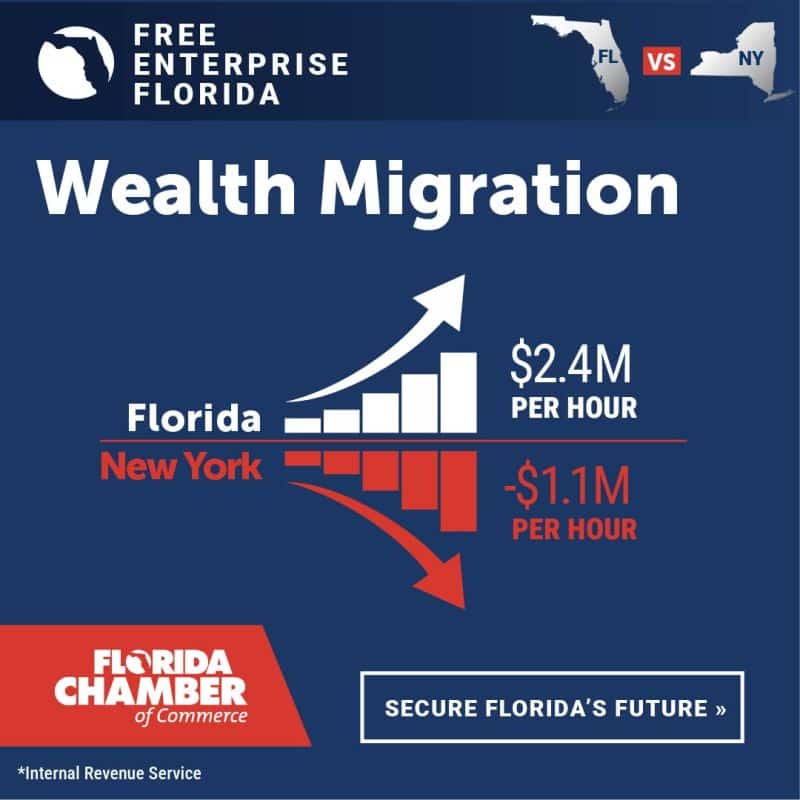
Image from FLchamber.com

New York vs Miami: What ‘wealth migration’ really measures, and why Florida remains strong

New York is still a logical place to do business. It remains a global financial center with an enormous concentration of capital, talent, and decision-makers, and it is no coincidence that we have an office there. At the same time, Miami, and South Florida more broadly, has demonstrably become a stronger magnet in recent years for high-net-worth individuals and for financial services firms. So the honest story is not “Miami replaces Manhattan,” but a shift in which Florida is gaining more weight in the ecosystem.

Why the public debate often talks past itself

In media and on social platforms, “wealth migration” is often presented as one single thing. In reality, three different metrics are frequently mixed up:

  • Migration counts: (how many people move in or out)
  • Income migration: (how much income moves with those taxpayers, often based on IRS data such as AGI)
  • “Wealth” in the literal sense: a person’s total net worth, including investments, business interests, and real estate)

These three are not the same. Migration figures can indicate something about income associated with relocations, but they are not a direct measurement of “wealth leaving the state,” and certainly not proof of “so much tax money has disappeared.”

New York remains a global hub, but Miami is steadily gaining ground

What is actually happening: people move, and the ecosystem moves with them

The trend is real and has been visible for some time: wealthy New Yorkers are relocating their primary residence to Florida, particularly to Miami and Palm Beach. Notably, it’s not just households that are making the move. South Florida is also attracting:

  • financial services firms
  • investment professionals
  • entrepreneurs and founders
  • family offices and related service providers

That is what makes the difference. The story is not only about “where people live,” but also about the build-out of a financial ecosystem in South Florida. New York remains a core hub in that picture, but Florida is no longer just a lifestyle destination.

Why Florida is so attractive, and why it is not automatically “only taxes”

The fiscal difference is a major driver: Florida does not levy a state-level personal income tax. For high earners, moving their tax residency can therefore make a substantial difference.
But it is too simplistic to treat migration numbers as automatic proof that taxes always decide everything. In practice, other factors also play a role, such as:
  • lifestyle and climate
  • family considerations
  • housing and cost of living
  • business opportunities and networks in South Florida
  • travel and connectivity (including international access)

Why it is such a hot topic right now: two discussions are overlapping

Two separate conversations are often blended together, and you need to separate them:

  1. People buying property in Florida or spending more time there
  2. People actually changing their tax residency and moving their primary domicile

Important detail: an increase in purchase interest or more apartment applications in Miami is not proof that someone has truly changed their tax residency.

How big is the shift, and what do headlines like “$14 billion” really mean?

The Citizens Budget Commission analyzed how much income moves with relocating residents. In reporting about that analysis, it is often stated that nearly $14 billion in income was associated with moves from New York City to Florida over a multi-year period through 2022.
 
The nuance is crucial: the commission emphasizes that you cannot directly infer from that figure how much tax revenue New York City lost.
 
A helpful way to keep it clear:
  • Income migration is not the same as
  • lost tax revenue, and it is also not the same as
  • a full inventory of “wealth” leaving the state

That is why headlines like “New York loses $14 billion in wealth” can be misleading. The underlying figures are about income, not $14 billion in vanished tax revenue or a full net-worth calculation.

Owning a home in Florida is not enough: New York does not let go easily

A second home in Florida does not automatically mean New York releases you for tax purposes. New York looks at your true permanent home (domicile). In addition, someone with a primary home outside New York can still be taxed as a resident if they:
  • maintain a permanent place of abode in New York, and
  • spend 184 days or more in New York during the year
The difference is significant between:
  • having a second home, versus
  • making a legally defensible change of domicile and tax residency

Are claims like “$2.4 million per hour into Florida” and “$1.1 million per hour out of New York” correct?

Yes, the Florida Chamber does use figures like that, but again, income is the key word. It is not “wealth literally being wired every hour.”
The Florida Chamber bases this indicator on IRS migration data: the adjusted gross income (AGI) of incoming taxpayers minus that of outgoing taxpayers. That annual net balance is then expressed as an average per hour.
Converted on a 365-day basis, the rounded figures imply a certain annual net AGI movement, but three nuances always matter:
  1. It is an average, not a live counter
  2. It measures AGI, not total wealth
  3. Florida’s and New York’s numbers are not automatically mirror images, because migration flows involve multiple states

So what is the core takeaway?

Florida is attracting purchasing power and part of the tax base, while New York has to weigh how much it can ask from high earners without making departure more attractive. The migration is measurable, but the claim that one politician or one tax proposal is the single cause is far less solidly supported.

Want to make this practical for your situation?

For entrepreneurs and investors, the practical conclusion is usually the most relevant: New York remains strategically strong, but Miami and South Florida have structurally strengthened as a place to live, invest, and build a finance and business network. The question is not “NY or Miami,” but which combination fits your growth, your team, your customers, and your tax reality.
 
Want to discuss your US readiness as a supplier, including structure, compliance, and supply chain choices? Schedule a call. We are happy to help with personal advice.

We are happy to assist you with personalized advice.

FAQ’s 

1) Does “wealth migration” mean wealth literally disappears from New York?

No. In many publications, it refers to income migration (for example AGI from IRS data), not a full inventory of someone’s total wealth such as investments, business interests, or real estate. “Wealth” is often used as a broad term, while the measurement is usually about income.

2) Does New York automatically lose the same amount of tax revenue as the income that moved?

No. Income that moved and tax revenue lost are not the same. To estimate tax effects, you need additional assumptions (rates, deductions, local taxes, behavioral effects). So you cannot directly infer lost tax revenue from an income-migration figure.

3) Is Miami “the new Manhattan”?

Miami and South Florida are clearly building a stronger financial ecosystem, but it is not a 1-to-1 replacement. New York remains a global financial center with unique scale, market depth, and decision-making power. In practice, it is more of a split: New York as the international hub, Florida as a growing second pole for living, networking, and certain types of finance and entrepreneurship.

4) Is the tax advantage the only reason people move to Florida?

Taxes often play a major role because Florida has no state-level personal income tax. But migration numbers do not prove it is always the decisive factor. Lifestyle, family, housing, and business opportunities in South Florida also matter. It is usually a combination.

5) If I buy a home in Florida, am I automatically no longer a New York resident?

No. New York looks at your true permanent home (domicile). Also, even with a primary home outside New York, you can still be taxed as a resident if you keep a permanent place of abode in New York and spend 184 days or more in New York. A second home in Florida is not the same as a legally defensible change of tax residency.

6) Are claims like “$2.4 million per hour into Florida” and “$1.1 million per hour out of New York” accurate?

The Florida Chamber uses these kinds of figures, but it is an hourly conversion of a net AGI migration indicator based on IRS data. It is not a live counter and not a measurement of wealth being transferred every hour. Also, Florida’s and New York’s figures are not automatically mirror images, because migration flows involve multiple states.

Webmaster

The Van Holland Group team is the one-stop shop for entrepreneurs looking to start or expand their business in the United States. With offices in Baarn and Eindhoven (Netherlands), Düsseldorf (Germany), and Miami, Houston, and New York (USA), plus a hub network covering all 50 states, we are the leading USA specialists with over 25 years of experience.

We offer a full spectrum of services, including market research, business consultancy, company incorporation, and ongoing support. In addition, we provide back office support, bookkeeping services, and visa assistance. We can even help you find investors and raise capital.

Our team of specialists is ready to guide you every step of the way. From initial market exploration and partner search, to company formation, and all the way through to building a complete sales and marketing organization.

https://www.vanhollandgroup.com
Skip to content